
The Ins and Outs of Self-Taught Art
Reflections on a Shifting Field
January 10, 2012 - April 7, 2012
The Lady and the Tramp
Images of Women in Austrian and German Art
October 11, 2011 - December 30, 2011
Recent Acquisitions
(And Some Thoughts on the Current Art Market)
July 5, 2011 - September 30, 2011
Decadence & Decay
Max Beckmann, Otto Dix, George Grosz
April 12, 2011 - June 24, 2011
Self-Taught Painters in American 1800-1950
Revisiting the Tradition
January 11, 2011 - April 2, 2011
Marie-Louise Motesiczky
Paradise Lost & Found
October 12, 2010 - December 30, 2010
Recent Acquisitions
(And Some Thoughts on the Current Art Market)
July 13, 2010 - October 1, 2010
Käthe Kollwitz
A Portrait of the Artist
April 13, 2010 - June 25, 2010
Seventy Years Grandma Moses
A Loan Exhibition Celebrating the 70th Anniversary of the Artist's "Discovery"
February 3, 2010 - April 3, 2010
Egon Schiele as Printmaker
A Loan Exhibition Celebrating the 70th Anniversary of the Galerie St. Etienne
November 3, 2009 - January 23, 2010
From Brücke To Bauhaus
The Meanings of Modernity in Germany, 1905-1933
March 31, 2009 - June 26, 2009
They Taught Themselves
American Self-Taught Painters Between the World Wars
January 9, 2009 - March 14, 2009
Elephants We Must Never Forget
New Paintings Drawings and Prints by Sue Coe
October 14, 2008 - December 20, 2008
Recent Acquisitions
(And Some Thoughts on the Current Art Market)
June 24, 2008 - September 26, 2008
Hope or Menace?
Communism in Germany Between the World Wars
March 25, 2008 - June 13, 2008
Transforming Reality
Pattern and Design in Modern and Self-Taught Art
January 15, 2008 - March 8, 2008
Leonard Baskin
Proofs and Process
October 9, 2007 - January 5, 2008
Recent Acquisitions
(And Some Thoughts on the Current Art Market)
June 5, 2007 - September 28, 2007
Who Paid the Piper?
The Art of Patronage in Fin-de-Siècle Vienna
March 8, 2007 - May 26, 2007
Fairy Tale, Myth and Fantasy
Approaches to Spirituality in Art
December 7, 2006 - February 3, 2007
More Than Coffee was Served
Café Culture in Fin-de-Siècle Vienna and Weimar Germany
September 19, 2006 - November 25, 2006
Recent Acquisitions
(And Some Thoughts on the Current Art Market)
June 6, 2006 - September 8, 2006
Parallel Visions II
"Outsider" and "Insider" Art Today
April 5, 2006 - May 26, 2006
Ilija!
His First American Exhibtion
January 17, 2006 - March 18, 2006
Coming of Age
Egon Schiele and the Modernist Culture of Youth
November 15, 2005 - January 7, 2006
Sue Coe:
Sheep of Fools
September 20, 2005 - November 5, 2005
Recent Acquisitions
And Some Thoughts on the Current Art Market
June 7, 2005 - September 9, 2005
Every Picture Tells a Story
The Narrative Impulse in Modern and Contemporary Art
April 5, 2005 - May 27, 2005
65th Anniversary Exhibition, Part II
Self-Taught Artists
January 18, 2005 - March 26, 2005
65th Anniversary Exhibition, Part I
Austrian and German Expressionism
October 28, 2004 - January 8, 2005
Sue Coe: Bully: Master of the Global Merry-Go-Round and Recent Acquisitions
(And Some Thoughts on the Current Art Market)
June 8, 2004 - October 16, 2004
Animals & Us
The Animal in Contemporary Art
April 1, 2004 - May 22, 2004
Henry Darger
Art and Myth
January 15, 2004 - March 20, 2004
Body and Soul
Expressionism and the Human Figure
October 7, 2003 - January 3, 2004
Recent Acquisitions
(And Some Thoughts on the Current Art Market)
June 24, 2003 - September 12, 2003
In Search of the "Total Artwork"
Viennese Art and Design 1897–1932
April 8, 2003 - June 14, 2003
Russia's Self-Taught Artists
A New Perspective on the "Outsider"
January 14, 2003 - March 29, 2003
Käthe Kollwitz:
Master Printmaker
October 1, 2002 - January 4, 2003
Recent Acquisitions
(And Some Thoughts on the Current Art Market)
June 25, 2002 - September 20, 2002
Workers of the World
Modern Images of Labor
April 2, 2002 - June 15, 2002
Grandma Moses
Reflections of America
January 15, 2002 - March 16, 2002
Gustav Klimt/Egon Schiele/Oskar Kokoscha
From Art Nouveau to Expressionism
November 23, 2001 - January 5, 2002
The "Black-and-White" Show
Expressionist Graphics in Austria & Germany
September 20, 2001 - November 10, 2001
Recent Acquisitions (And Some Thoughts on the Current Art Market)
June 26, 2001 - September 7, 2001
Art with an Agenda
Politics, Persuasion, Illustration and Decoration
April 10, 2001 - June 16, 2001
"Our Beautiful and Tormented Austria!": Art Brut in the Land of Freud
January 18, 2001 - March 17, 2001
The Tragedy of War
November 16, 2000 - January 6, 2001
The Expressionist City
September 19, 2000 - November 4, 2000
Recent Acquisitions (And Some Thoughts on the Current Art Market)
June 20, 2000 - September 8, 2000
From Façade to Psyche
Turn-of-the-Century Portraiture in Austria & Germany
March 28, 2000 - June 10, 2000
European Self-Taught Art
Brut or Naive?
January 18, 2000 - March 11, 2000
Saved From Europe
In Commemoration of the 60th Anniversary of the Galerie St. Etienne
November 6, 1999 - January 8, 2000
The Modern Child
(Images of Children in Twentieth-Century Art)
September 14, 1999 - November 6, 1999
Recent Acquisitions
(And a Look at Sixty Years of Art Dealing)
June 15, 1999 - September 3, 1999
Sue Coe: The Pit
The Tragical Tale of the Rise and Fall of a Vivisector
March 30, 1999 - June 5, 1999
Henry Darger and His Realms
January 14, 1999 - March 13, 1999
Becoming Käthe Kollwitz
An Artist and Her Influences
November 17, 1998 - December 31, 1998
George Grosz - Elfriede Lohse-Wächtler
Art & Gender in Weimar Germany
September 23, 1998 - November 11, 1998
Recent Acquisitions
(And Some Thoughts About Looted Art)
June 9, 1998 - September 11, 1998
Taboo
Repression and Revolt in Modern Art
March 26, 1998 - May 30, 1998
Sacred & Profane
Michel Nedjar and Expressionist Primitivism
January 13, 1998 - March 14, 1998
Egon Schiele (1890-1918)
Master Draughtsman
November 18, 1997 - January 3, 1998
The New Objectivity
Realism in Weimar-Era Germany
September 16, 1997 - November 8, 1997
Recent Acquisitions
A Question of Quality
June 10, 1997 - September 5, 1997
Käthe Kollwitz - Lea Grundig
Two German Women & The Art of Protest
March 25, 1997 - May 31, 1997
That Way Madness Lies
Expressionism and the Art of Gugging
January 14, 1997 - March 15, 1997
The Viennese Line
Art and Design Circa 1900
November 18, 1996 - January 4, 1997
Emil Nolde - Christian Rohlfs
Two German Expressionist Masters
September 24, 1996 - November 9, 1996
Breaking All The Rules
Art in Transition
June 11, 1996 - September 6, 1996
Sue Coe's Ship of Fools
March 26, 1996 - May 24, 1996
New York Folk
Lawrence Lebduska, Abraham Levin, Isreal Litwak
January 16, 1996 - March 16, 1996
The Fractured Form
Expressionism and the Human Body
November 15, 1995 - January 6, 1996
From Left to Right
Social Realism in Germany and Russia, Circa 1919-1933
September 19, 1995 - November 4, 1995
Recent Acquisitions
June 20, 1995 - September 8, 1995
On the Brink 1900-2000
The Turning of Two Centuries
March 28, 1995 - May 26, 1995
Earl Cummingham - Grandma Moses
Visions of America
January 17, 1995 - March 18, 1995
Three Berlin Artists of the Weimar Era: Hannah Höch, Käthe Kollwitz, Jeanne Mam
September 13, 1994 - November 5, 1994
55th Anniversary Exhibition in Memory of Otto Kallir
June 7, 1994 - September 2, 1994
Drawn to Text: Comix Artists as Book Illustrators
May 15, 1994 - January 7, 1995
Sue Coe: We All Fall Down
March 29, 1994 - May 27, 1994
The Forgotten Folk Art of the 1940's
January 18, 1994 - March 19, 1994
Symbolism and the Austrian Avant Garde
Klimt, Schiele and their Contemporaries
November 16, 1993 - January 8, 1994
Art and Politics in Weimar Germany
September 14, 1993 - November 6, 1993
Recent Acquisitions
June 8, 1993 - September 3, 1993
The "Outsider" Question
Non-Academic Art from 1900 to the Present
March 23, 1993 - May 28, 1993
The Dance of Death
Images of Mortality in German Art
January 19, 1993 - March 13, 1993
Art Spiegelman
The Road to Maus
November 17, 1992 - January 9, 1993
Käthe Kollwitz
In Celebration of the 125th Anniversary of the Artist's Birth
September 15, 1992 - November 7, 1992
Naive Visions/Art Nouveau and Expressionism/Sue Coe: The Road to the White House
May 19, 1992 - September 4, 1992
Richard Gerstl/Oskar Kokoschka
March 17, 1992 - May 9, 1992
Scandal, Outrage, Censorship
Controversy in Modern Art
January 21, 1992 - March 7, 1992
Viennese Graphic Design
From Secession to Expressionism
November 19, 1991 - January 11, 1992
The Expressionist Figure
September 10, 1991 - November 9, 1991
Recent Acquisitions
Themes and Variations
May 14, 1991 - August 16, 1991
Sue Coe Retrospective
Political Document of a Decade
March 12, 1991 - May 5, 1991
Gustav Klimt, Egon Schiele, Oskar Kokoschka
Watercolors, drawings and prints
January 22, 1991 - March 2, 1991
Egon Schiele
November 13, 1990 - January 12, 1991
Lovis Corinth
A Retrospective
September 11, 1990 - November 3, 1990
Recent Acquisitions
June 12, 1990 - August 31, 1990
Max Klinger, Käthe Kollwitz, Alfred Kubin
A Study in Influences
March 27, 1990 - June 2, 1990
The Narrative in Art
January 23, 1990 - March 17, 1990
Grandma Moses
November 14, 1989 - January 13, 1990
Sue Coe
Porkopolis--Animals and Industry
September 19, 1989 - November 4, 1989
Galerie St. Etienne
A History in Documents and Pictures
June 20, 1989 - September 8, 1989
Gustav Klimt
Paintings and Drawings
April 11, 1989 - June 10, 1989
Fifty Years Galerie St. Etienne: An Overview
February 14, 1989 - April 1, 1989
Folk Artists at Work
Morris Hirshfield, John Kane and Grandma Moses
November 15, 1988 - January 14, 1989
Recent Acquisitions and Works From the Collection
June 14, 1988 - September 16, 1988
From Art Nouveau to Expressionism
April 12, 1988 - May 27, 1988
Three Pre-Expressionists
Lovis Corinth Käthe Kollwitz Paula Modersohn-Becker
January 26, 1988 - March 12, 1988
Käthe Kollwitz
The Power of the Print
November 17, 1987 - January 16, 1988
Recent Acquisitions and Works From the Collection
April 7, 1987 - October 31, 1987
Folk Art of This Century
February 10, 1987 - March 28, 1987
Oskar Kokoschka and His Time
November 25, 1986 - January 31, 1987
Viennese Design and Wiener Werkstätte
September 23, 1986 - November 8, 1986
Gustav Klimt/Egon Schiele/Oskar Kokoschka
Watercolors, Drawings and Prints
May 27, 1986 - September 13, 1986
Expressionist Painters
March 25, 1986 - May 10, 1986
Käthe Kollwitz/Paula Modersohn-Becker
January 28, 1986 - March 15, 1986
The Art of Giving
December 3, 1985 - January 18, 1986
Expressionists on Paper
October 8, 1985 - November 23, 1985
European and American Landscapes
June 4, 1985 - September 13, 1985
Expressionist Printmaking
Aspects of its Genesis and Development
April 1, 1985 - May 24, 1985
Expressionist Masters
January 18, 1985 - March 23, 1985
Arnold Schoenberg's Vienna
November 13, 1984 - January 5, 1985
Grandma Moses and Selected Folk Paintings
September 25, 1984 - November 3, 1984
American Folk Art
People, Places and Things
June 12, 1984 - September 14, 1984
John Kane
Modern America's First Folk Painter
April 17, 1984 - May 25, 1984
Eugène Mihaesco
The Illustrator as Artist
February 28, 1984 - April 7, 1984
Early Expressionist Masters
January 17, 1984 - February 18, 1984
Paula Modersohn-Becker
Germany's Pioneer Modernist
November 15, 1983 - January 7, 1984
Gustav Klimt
Drawings and Selected Paintings
September 20, 1983 - November 5, 1983
Early and Late
Drawings, Paintings & Prints from Academicism to Expressionism
June 1, 1983 - September 2, 1983
Alfred Kubin
Visions From The Other Side
March 22, 1983 - May 7, 1983
20th Century Folk
The First Generation
January 18, 1983 - March 12, 1983
Grandma Moses
The Artist Behind the Myth
November 15, 1982 - January 8, 1983
Kollwitz
The Artist as Printmaker
September 28, 1982 - November 6, 1982
Aspects of Modernism
June 1, 1982 - September 3, 1982
The Human Perspective
Recent Acquisitions
March 16, 1982 - May 15, 1982
19th and 20th Century European and American Folk Art
January 19, 1982 - March 6, 1982
The Folk Art Tradition
Naïve Painting in Europe and the United States
November 17, 1981 - January 9, 1982
Austria's Expressionism
April 21, 1981 - May 30, 1981
Eugène Mihaesco
His First American One-Man Show
March 3, 1981 - April 11, 1981
Gustav Klimt, Egon Schiele
November 12, 1980 - December 27, 1980
Summer Exhibition
June 17, 1980 - October 31, 1980
Kollwitz: The Drawing and The Print
May 1, 1980 - June 10, 1980
40th Anniversary Exhibition
November 13, 1979 - December 28, 1979
American Primitive Art
November 22, 1977
Käthe Kollwitz
December 1, 1976
Neue Galerie-Galerie St. Etienne
A Documentary Exhibition
May 1, 1976
Martin Pajeck
January 27, 1976
Georges Rouault and Frans Masereel
April 29, 1972
Branko Paradis
December 1, 1971
Käthe Kollwitz
February 3, 1971
Egon Schiele
The Graphic Work
October 19, 1970
Gustav Klimt
March 20, 1970
Friedrich Hundertwasser
May 6, 1969
Austrian Art of the 20th Century
March 21, 1969
Egon Schiele
Memorial Exhibition
October 31, 1968
Yugoslav Primitive Art
April 30, 1968
Alfred Kubin
January 30, 1968
Käthe Kollwitz
In the Cause of Humanity
October 23, 1967
Abraham Levin
September 26, 1967
Karl Stark
April 5, 1967
Gustav Klimt
February 4, 1967
The Wiener Werkstätte
November 16, 1966
Oskar Laske
October 25, 1965
Käthe Kollwitz
May 1, 1965
Egon Schiele
Watercolors and Drawings from American Collections
March 1, 1965
25th Anniversary Exhibition
Part II
November 21, 1964
25th Anniversary Exhibition
Part I
October 17, 1964
Mary Urban
June 9, 1964
Werner Berg, Jane Muus and Mura Dehn
May 5, 1964
Eugen Spiro
April 4, 1964
B. F. Dolbin
Drawings of an Epoch
March 3, 1964
Austrian Expressionists
January 6, 1964
Joseph Rifesser
December 3, 1963
Panorama of Yugoslav Primitive Art
October 21, 1963
Joe Henry
Watercolors of Vermont
May 1, 1963
French Impressionists
March 8, 1963
Grandma Moses
Memorial Exhibition
November 26, 1962
Group Show
October 15, 1962
Ernst Barlach
March 23, 1962
Martin Pajeck
February 24, 1962
Paintings by Expressionists
January 27, 1962
Käthe Kollwitz
November 11, 1961
Grandma Moses
September 7, 1961
My Friends
Fourth Biennial of Pictures by American School Children
May 27, 1961
Raimonds Staprans
April 17, 1961
Gustav Klimt, Egon Schiele, Oskar Kokoschka and Alfred Kubin
March 14, 1961
Marvin Meisels
January 23, 1961
Egon Schiele
November 15, 1960
My Life's History
Paintings by Grandma Moses
September 12, 1960
Watercolors and Drawings by Austrian Artists from the Dial Collection
May 2, 1960
Martin Pajeck
February 29, 1960
Eugen Spiro
February 6, 1960
Käthe Kollwitz
December 14, 1959
Josef Scharl
Last Paintings and Drawings
November 11, 1959
European and American Expressionists
September 22, 1959
Our Town
One Hundred Paintings by American School Children
May 23, 1959
Marvin Meisels and Martin Pajeck
May 1, 1959
Gustav Klimt
April 1, 1959
Käthe Kollwitz
January 12, 1959
Oskar Kokoschka
October 28, 1958
Village Life in Guatemala
Paintings by Andres Curuchich
June 3, 1958
Two Unknown American Expressionists
Paintings by Marvin Meisels and Martin Pajeck
April 28, 1958
Paula Modersohn-Becker
March 15, 1958
The Great Tradition in American Painting
American Primitive Art
January 20, 1958
Jules Lefranc and Dominique Lagru
Two French Primitives
November 18, 1957
Margret Bilger
October 22, 1957
The Four Seasons
One Hundred Paintings by American School Children
June 11, 1957
Grandma Moses
May 6, 1957
Alfred Kubin
April 3, 1957
Franz Lerch
March 2, 1957
Egon Schiele
January 21, 1957
Josef Scharl
Memorial Exhibition
November 17, 1956
Irma Rothstein
May 19, 1956
Käthe Kollwitz
April 16, 1956
A Tribute to Grandma Moses
November 28, 1955
As I See Myself
One Hundred Paintings by American School Children
May 20, 1955
Juan De'Prey
April 19, 1955
Erich Heckel
March 29, 1955
Freddy Homburger
March 2, 1955
Masters of the 19th Century
January 18, 1955
Oskar Kokoschka
November 29, 1954
Isabel Case Borgatta and Josef Scharl
October 12, 1954
James N. Rosenberg and Eugen Spiro
April 30, 1954
Per Krogh
April 2, 1954
Cuno Amiet
February 16, 1954
Eniar Jolin
January 14, 1954
Irma Rothstein
December 8, 1953
Josef Scharl
November 11, 1953
Grandma Moses
October 21, 1953 - October 24, 1953
Wilhelm Kaufmann
September 30, 1953
Lovis Corinth, Oskar Kokoschka and Egon Schiele
May 27, 1953
A Grandma Moses Album
Recent Paintings, 1950-1953
April 15, 1953
Streeter Blair
American Primitive
February 26, 1953
Paintings on Glass
Austrian Religious Folk Art of the 17th to 19th Centuries
December 4, 1952
Hasan Kaptan
Paintings of a Ten-Year-Old Turkish Painter
October 29, 1952
Margret Bilger
May 10, 1952
American Natural Painters
March 31, 1952
Ten Years of New York Concert Impressions by Eugen Spiro; Four New Paintings by
January 26, 1952
I-Fa-Wei
Watercolors of New York by a Chinese Artist
December 1, 1951
Käthe Kollwitz
October 25, 1951
Drawings and Watercolors by Austrian Children
May 21, 1951
Grandma Moses
Twenty-Five Masterpieces of Primitive Art
March 17, 1951
Roswitha Bitterlich
January 18, 1951
Oskar Laske
Watercolors of Vienna and the Salzkammergut
October 14, 1950
Tenth Anniversary Exhibition
Part II
May 11, 1950
Austrian Art of the 19th Century
From Wadlmüller to Klimt
April 1, 1950
Chiao Ssu-Tu
February 18, 1950
Anton Faistauer
January 1, 1950
Tenth Anniversary Exhibition
Part I
November 30, 1949
Autograph Exhibition
October 26, 1949
Gladys Wertheim Bachrach
May 24, 1949
Oskar Kokoschka
March 30, 1949
Eugen Spiro
February 19, 1949
Frans Masereel
January 13, 1949
Ten Years Grandma Moses
November 22, 1948
Käthe Kollwitz
Masterworks
October 18, 1948
American Primitives
June 3, 1948
Egon Schiele
Memorial Exhibition
April 5, 1948
Miriam Richman
February 7, 1948
Vally Wieselthier
Memorial Exhibition
January 10, 1948
Christmas Exhibition
December 4, 1947
Fritz von Unruh
November 10, 1947
Käthe Kollwitz
October 4, 1947
Grandma Moses
May 17, 1947
Lovis Corinth
April 16, 1947
Hugo Steiner-Prag
March 15, 1947
Mark Baum
January 11, 1947
Eugen Spiro
November 25, 1946
Henri de Toulouse-Lautrec
May 17, 1946
Ladis W. Sabo
Paintings by a New Primitive Artist
April 8, 1946
Georges Rouault
The Graphic Work
February 26, 1946
Käthe Kollwitz
Memorial Exhibition
November 21, 1945
Fred E. Robertson
Paintings by an American Primitive
June 13, 1945
Max Liebermann
The Graphic Work
April 18, 1945
Vienna through Four Centuries
March 1, 1945
Eugen Spiro
January 20, 1945
Grandma Moses
New Paintings
December 5, 1944
Käthe Kollwitz
Part II
October 26, 1944
A Century of French Graphic Art
From Géricault to Picasso
September 28, 1944
Max Liebermann
Memorial Exhibition
June 9, 1944
Juan De'Prey
Paintings by a Self-Taught Artist from Puerto Rico
May 6, 1944
Abraham Levin
April 15, 1944
Lesser Ury
Memorial Exhibition
March 21, 1944
Grandma Moses
Paintings by the Senior of the American Primitives
February 9, 1944
Betty Lane
January 11, 1944
WaIt Disney Cavalcade
December 9, 1943
Käthe Kollwitz
Part I
November 3, 1943
Will Barnet
September 29, 1943
Lovis Corinth
May 26, 1943
Josephine Joy
Paintings by an American Primitive
May 3, 1943
Oskar Kokoschka
Aspects of His Art
March 31, 1943
Eugen Spiro
February 13, 1943
Seymour Lipton
January 18, 1943
Illuminated Gothic Woodcuts
Printed and Painted, 1477-1493
December 5, 1942
Abraham Levin
November 4, 1942
Walt Disney Originals
September 23, 1942
Documents which Relate History
Documents of Historical Importance and Landmarks of Human Development
June 10, 1942
Honoré Daumier
April 29, 1942
Bertha Trabich
Memorial Exhibition of a Russian-American Primitive
March 25, 1942
Alfred Kubin
Master of Drawing
December 4, 1941
Egon Schiele
November 7, 1941
Betty Lane
June 3, 1941
Flowers from Old Vienna
18th and Early 19th Century Flower Painting
May 7, 1941
Weavings by Navaho and Hopi Indians and Photos of Indians by Helen M. Post
January 29, 1941
Georg Merkel
November 7, 1940
What a Farm Wife Painted
Works by Mrs. Anna Mary Moses
October 9, 1940
Saved from Europe
Masterpieces of European Art
July 1, 1940
American Abstract Art
May 22, 1940
Franz Lerch
May 1, 1940
Wilhelm Thöny
April 3, 1940
French Masters of the 19th and 20th Centuries
February 29, 1940
H. W. Hannau
Metropolis, Photographic Studies of New York
February 2, 1940
Oskar Kokoschka
January 9, 1940
Austrian Masters
November 13, 1939
NEW YORK FOLK
Lawrence Lebduska, Abraham Levin, Isreal Litwak
Lebduska, Lawrence
Levin, Abraham
Litwak, Israel
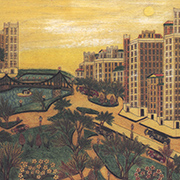
Two years ago, the Galerie St. Etienne mounted an exhibition titled “The Forgotten Folk Art of the 1940s.” One in a series of shows of self-taught artists we have been organizing annually to coincide with the Outsider Art Fair (where the gallery exhibits a broader array of non-academic material), “Forgotten Folk Art” focused on the watershed generation which, in the 1940s, initially established contemporary American self-taught art as a viable genre. The present exhibition, “New York Folk,” highlights three artists from that same generation: Lawrence Lebduska, Israel Litwak and Abraham Levin. Although New York City has long been the center of the American (and indeed, international) art world, folk art has, almost by definition, always been more diffuse, emerging from far-flung corners of the country. Lebduska, Litwak and Levin, on the other hand, are of interest in part because they were New Yorkers working in that city at the very moment when the entire self-taught field was first coalescing and being defined there.
The apotheosis of the self-taught artist into the modernist canon can be traced to the gala (if somewhat mocking) banquet that Picasso gave for Henri Rousseau in 1908, but it was not until 1927, when John Kane was admitted to the Carnegie International, that the genre received an official stamp of approval in America. The now legendary initial American exhibitions of folk art had featured pre-twentieth-century material, but in the late 1930s Alfred Barr at the fledgling Museum of Modern Art began legitimizing more contemporary work. MOMA hosted the first survey exhibition of twentieth-century non-academic art, “Masters of Popular Painting,” in 1938; Rousseau was given a one-man show at the museum in 1942, Morris Hirshfield in 1943. Establishing a pattern that has continued to characterize the field, many of the earliest collectors of contemporary self-taught work, such as Duncan Phillips, bought directly from the artists--at least in part because there were few dealers interested in that market. However, by 1940 a number of commercial galleries had entered the arena, and the ground was ripe for the first “boom” in contemporary non-academic art.
The beneficiaries of that first folk art boom, unlike all who came after, initially had no possible hope or expectations of ever succeeding as fine artists, for the field of self-taught art literally did not exist during their formative years. Lebduska, Litwak and Levin were part of the wave of Eastern and Central European immigration which flooded the less prosperous neighborhoods of New York City in the first decades of the twentieth century. Litwak and Levin came from Russia; Lebduska, though born in Baltimore, spent most of his childhood in Leipzig and his family’s native Bohemia, returning to the United States only in 1912. Undoubtedly their European backgrounds helped shape their aesthetic instincts, but none of the three men possessed the economic wherewithal to pursue an artistic career. Instead, they each earned their living at tasks that required a degree of manual dexterity, if not outright creative skill. Their artistic ambitions were nurtured primarily by the democratization of culture that accompanied the American industrial revolution. Museums, not yet hosts to blockbuster exhibitions, had been constructed as temples of culture for the masses. Free libraries--an additional resource that was used by many first-generation self-taught artists--performed a similar function. These trends were augmented by the proto-socialist tendencies of the Roosevelt era: both Lebduska and Levin found succor with the W.P.A., and Levin was also supported by his union, the Amalgamated Clothing Workers of America. It took only a little further encouragement on the part of the art world for Lebduska, Litwak and Levin to blossom forth as painters: they were simply in the right place at the right time.
Given Lawrence Lebduska’s seminal role in the history of twentieth-century American self-taught art, it is surprising that he is not better remembered. It would appear that Lebduska was the first such artist, after Kane, to come to the attention of the New York establishment. Already in the late 1920s, Lebduska was exhibiting at the Opportunity Gallery of the Art Centre on 56th Street, where his work caught the attention of the noted violinist Louis Kaufman. Lebduska’s first big success, however, seems to have been a near sell-out show in 1936 at the Contemporary Art Galleries. The few surviving works from this early period make it possible to trace the artist’s development: from fairy-tale scenes that still strongly bespeak his Czech origins (checklist #1), to brighter, more lyrical compositions that are tied to personal fantasy rather than to a specific narrative (checklist #s 2-4). Robert Bishop, the late director of the Museum of American Folk Art, credited Lebduska with having inspired Abby Aldrich Rockefeller to begin her landmark collection of American folk art (now housed in the eponymous museum at Williamsburg, Virginia). Lebduska was featured in the 1938 MOMA show, and in Sidney Janis’s groundbreaking 1942 book, They Taught Themselves (which in turn spawned an ancillary exhibition at the Marie Harriman Gallery). The folk art boom really took off with the discovery of Grandma Moses in 1940, but Lebduska, though continuing for a while to exhibit, appears already to have been fading. When he reemerged publicly in the 1960s, shortly before his death, mention was made of an artistic hiatus caused by protracted illness, and some have alluded to a chronic drinking problem. It is unfortunate that so far no more detailed biographical information on Lebduska has been assembled, for this would surely shed much needed light on his creative evolution as well as on the impact of art-world notoriety on someone whose early life and training had left him ill-prepared to cope.
One may speculate that Lebduska, who was employed for a time by the noted interior designer Elsie de Wolfe before going freelance, drifted fairly organically from decorative mural painting into the fine arts. Israel Litwak, on the other hand, belongs with those of his generation (most notably Moses and Hirshfield) who experienced a dramatic change of vocation upon reaching retirement age. Having worked most of his life as a cabinet maker and varnisher of furniture, Litwak turned to art only at the age of 68. His first works--today quite rare--were done in pencil and crayon on board and have an embossed look that Sidney Janis likened to that of tooled leather (checklist #41). By the late 1930s, the art establishment had grown quite receptive to the work of self-taught artists, and thus when Litwak showed his pictures to the staff at the Brooklyn Museum, he was almost immediately offered a show. That 1939 exhibition was only the second one-person presentation ever accorded a self-taught painter by a major metropolitan museum. (The honor of being first again belongs to Kane, who in 1936 was given a memorial retrospective at Pittsburgh’s Carnegie Museum.) In the 1940s, his stature reaffirmed by inclusion in Janis’s book, Litwak was taken in hand by the esteemed dealer J. B. Neumann. Like others who helped put non-academic art on the map during this period, Neumann was known primarily for fostering avant-garde European artists, particularly the German Expressionists. Possibly at Neumann’s urging, Litwak switched from crayon to paint, producing the boldly colored canvases that form the bulk of his surviving oeuvre. If he nonetheless achieved only modest success in the 1940s, it may be because his jarring juxtapositions, distorted sense of scale and clashing color harmonies were incompatible with the increasingly serene and bucolic stereotype of folk art associated with Grandma Moses. Litwak’s sensibilities, by comparison, are far more in line with those of today’s “Outsiders” than they are with his own time.
The self-taught artist, who is often “naive” or unsophisticated only in the sense of being a complete stranger to the ways of the art world, has always been especially handicapped in dealing with the commercial gallery system. Even trained artists are, after all, frequently ill-equipped to handle the vicissitudes of fame, but the sad truth is that, in addition to talent and integrity of vision, it takes almost superhuman strength of character for the untrained artist to transcend the pressures of the marketplace. Kane, Horace Pippin and Hirshfield all grappled with this problem, but each died before experiencing the full brunt of a protracted artistic career. Moses, alone among her generation, enjoyed sustained professional success without compromising her artistic standards. Some of the more noteworthy artists unearthed courtesy of the ongoing “Outsider” phenomenon (for example, Henry Darger, Martin Ramirez and Bill Traylor) sidestepped the whole issue by remaining remote from the art crowd, which only caught on to them posthumously. Abraham Levin, on the other hand, may serve as a case study of how the hothouse climate of the New York art scene in the 1940s brought a genuine talent to accelerated flowering and then, just as quickly, killed it off.
Levin emigrated to the United States from Lithuania at the age of 23 and spent the next 34 years working at sewing kneepants in New York’s garment district, a job he thoroughly despised. A friend suggested he take some of the drawings he had been doing in his spare time to the local W.P.A. art school, and there he was immediately hailed as a great talent. Encouraged to try oils, he quickly produced three dozen canvases, which earned him a show at the Uptown Gallery in 1941. Howard Devree, the art critic for The New York Times, waxed rhapsodic about the exhibition, calling it “a thrilling experience” and the artist “extraordinary. . . . a true original.” The Amalgamated Clothing Workers of America, heartened by the critical acclaim, agreed to purchase 25 paintings on a kind of installment plan, providing Levin with a weekly stipend that allowed him to paint full time. Less than a year later, he had produced a further 25 canvases of sufficient quality that Otto Kallir, founder of the Galerie St. Etienne and discoverer of Grandma Moses, rejiggered his exhibition schedule in order to accommodate another one-man show. Again, Levin was heralded as a “sensation,” the promise of his first exhibition confirmed and fulfilled by the second. Fairly detailed records make it possible to piece together what happened next. The St. Etienne exhibition had not been a financial success, but Levin, bedazzled by the reviews, insisted on raising his prices. He was painting up a storm--almost as though he feared that even a moment’s hesitation would cause his miraculous artistic career to vanish. By 1944, he had enough work for yet another exhibition, but the magic was gone, the show this time a complete failure. By 1946, he was forced to beg for his old garment industry job.
The rise and fall of Lebduska, Litwak and Levin carries lessons that seem especially portentous in the context of today’s frenetic “Outsider” boom. Of 30 artists featured in They Taught Themselves, easily two-thirds are today completely forgotten; only a handful (Hirshfield, Kane, Moses, Pippin and perhaps Joseph Pickett) remain really well known. Between the folk art craze of the 1940s and the gradual resurgence of interest in “Outsiders” came three decades during which many scholars seriously argued that twentieth-century self-taught art did not--indeed could not--legitimately exist. There are, in fact, distinct parallels between the 1940s and the present moment. America was, in the earlier period, still reeling from the impact of the Great Depression, just as we are now coming to grips with our loss of political and economic stature as a global superpower. The grass-roots nature of self-taught art serves as an antidote to this sense of malaise by making Americans feel good about themselves, about their innate talents and resiliency. That folk art is a relatively low-budget collectible is also a fact that has never been lost on its adherents, particularly in times of economic retrenchment. More significantly, non-academic art has always acted as the conscience of the avant-garde: a lesson in pure, unmediated artistic expression, a way to replenish the creative juices when they seem to have run dry. Thus folk art served as a vital inspiration in the ‘40s, when America had not yet developed a native avant-garde of international standing, just as “Outsider” art seems fresher and more interesting than much of today’s post-modernist groping. Folk art booms will come and--inevitably--go, but quality will always survive. Not only can great non-academic art hold its own next to the work of great trained artists, but the two strands are so intertwined within the context of modern art history that the one cannot exist without the other.