
The Ins and Outs of Self-Taught Art
Reflections on a Shifting Field
January 10, 2012 - April 7, 2012
The Lady and the Tramp
Images of Women in Austrian and German Art
October 11, 2011 - December 30, 2011
Recent Acquisitions
(And Some Thoughts on the Current Art Market)
July 5, 2011 - September 30, 2011
Decadence & Decay
Max Beckmann, Otto Dix, George Grosz
April 12, 2011 - June 24, 2011
Self-Taught Painters in American 1800-1950
Revisiting the Tradition
January 11, 2011 - April 2, 2011
Marie-Louise Motesiczky
Paradise Lost & Found
October 12, 2010 - December 30, 2010
Recent Acquisitions
(And Some Thoughts on the Current Art Market)
July 13, 2010 - October 1, 2010
Käthe Kollwitz
A Portrait of the Artist
April 13, 2010 - June 25, 2010
Seventy Years Grandma Moses
A Loan Exhibition Celebrating the 70th Anniversary of the Artist's "Discovery"
February 3, 2010 - April 3, 2010
Egon Schiele as Printmaker
A Loan Exhibition Celebrating the 70th Anniversary of the Galerie St. Etienne
November 3, 2009 - January 23, 2010
From Brücke To Bauhaus
The Meanings of Modernity in Germany, 1905-1933
March 31, 2009 - June 26, 2009
They Taught Themselves
American Self-Taught Painters Between the World Wars
January 9, 2009 - March 14, 2009
Elephants We Must Never Forget
New Paintings Drawings and Prints by Sue Coe
October 14, 2008 - December 20, 2008
Recent Acquisitions
(And Some Thoughts on the Current Art Market)
June 24, 2008 - September 26, 2008
Hope or Menace?
Communism in Germany Between the World Wars
March 25, 2008 - June 13, 2008
Transforming Reality
Pattern and Design in Modern and Self-Taught Art
January 15, 2008 - March 8, 2008
Leonard Baskin
Proofs and Process
October 9, 2007 - January 5, 2008
Recent Acquisitions
(And Some Thoughts on the Current Art Market)
June 5, 2007 - September 28, 2007
Who Paid the Piper?
The Art of Patronage in Fin-de-Siècle Vienna
March 8, 2007 - May 26, 2007
Fairy Tale, Myth and Fantasy
Approaches to Spirituality in Art
December 7, 2006 - February 3, 2007
More Than Coffee was Served
Café Culture in Fin-de-Siècle Vienna and Weimar Germany
September 19, 2006 - November 25, 2006
Recent Acquisitions
(And Some Thoughts on the Current Art Market)
June 6, 2006 - September 8, 2006
Parallel Visions II
"Outsider" and "Insider" Art Today
April 5, 2006 - May 26, 2006
Ilija!
His First American Exhibtion
January 17, 2006 - March 18, 2006
Coming of Age
Egon Schiele and the Modernist Culture of Youth
November 15, 2005 - January 7, 2006
Sue Coe:
Sheep of Fools
September 20, 2005 - November 5, 2005
Recent Acquisitions
And Some Thoughts on the Current Art Market
June 7, 2005 - September 9, 2005
Every Picture Tells a Story
The Narrative Impulse in Modern and Contemporary Art
April 5, 2005 - May 27, 2005
65th Anniversary Exhibition, Part II
Self-Taught Artists
January 18, 2005 - March 26, 2005
65th Anniversary Exhibition, Part I
Austrian and German Expressionism
October 28, 2004 - January 8, 2005
Sue Coe: Bully: Master of the Global Merry-Go-Round and Recent Acquisitions
(And Some Thoughts on the Current Art Market)
June 8, 2004 - October 16, 2004
Animals & Us
The Animal in Contemporary Art
April 1, 2004 - May 22, 2004
Henry Darger
Art and Myth
January 15, 2004 - March 20, 2004
Body and Soul
Expressionism and the Human Figure
October 7, 2003 - January 3, 2004
Recent Acquisitions
(And Some Thoughts on the Current Art Market)
June 24, 2003 - September 12, 2003
In Search of the "Total Artwork"
Viennese Art and Design 1897–1932
April 8, 2003 - June 14, 2003
Russia's Self-Taught Artists
A New Perspective on the "Outsider"
January 14, 2003 - March 29, 2003
Käthe Kollwitz:
Master Printmaker
October 1, 2002 - January 4, 2003
Recent Acquisitions
(And Some Thoughts on the Current Art Market)
June 25, 2002 - September 20, 2002
Workers of the World
Modern Images of Labor
April 2, 2002 - June 15, 2002
Grandma Moses
Reflections of America
January 15, 2002 - March 16, 2002
Gustav Klimt/Egon Schiele/Oskar Kokoscha
From Art Nouveau to Expressionism
November 23, 2001 - January 5, 2002
The "Black-and-White" Show
Expressionist Graphics in Austria & Germany
September 20, 2001 - November 10, 2001
Recent Acquisitions (And Some Thoughts on the Current Art Market)
June 26, 2001 - September 7, 2001
Art with an Agenda
Politics, Persuasion, Illustration and Decoration
April 10, 2001 - June 16, 2001
"Our Beautiful and Tormented Austria!": Art Brut in the Land of Freud
January 18, 2001 - March 17, 2001
The Tragedy of War
November 16, 2000 - January 6, 2001
The Expressionist City
September 19, 2000 - November 4, 2000
Recent Acquisitions (And Some Thoughts on the Current Art Market)
June 20, 2000 - September 8, 2000
From Façade to Psyche
Turn-of-the-Century Portraiture in Austria & Germany
March 28, 2000 - June 10, 2000
European Self-Taught Art
Brut or Naive?
January 18, 2000 - March 11, 2000
Saved From Europe
In Commemoration of the 60th Anniversary of the Galerie St. Etienne
November 6, 1999 - January 8, 2000
The Modern Child
(Images of Children in Twentieth-Century Art)
September 14, 1999 - November 6, 1999
Recent Acquisitions
(And a Look at Sixty Years of Art Dealing)
June 15, 1999 - September 3, 1999
Sue Coe: The Pit
The Tragical Tale of the Rise and Fall of a Vivisector
March 30, 1999 - June 5, 1999
Henry Darger and His Realms
January 14, 1999 - March 13, 1999
Becoming Käthe Kollwitz
An Artist and Her Influences
November 17, 1998 - December 31, 1998
George Grosz - Elfriede Lohse-Wächtler
Art & Gender in Weimar Germany
September 23, 1998 - November 11, 1998
Recent Acquisitions
(And Some Thoughts About Looted Art)
June 9, 1998 - September 11, 1998
Taboo
Repression and Revolt in Modern Art
March 26, 1998 - May 30, 1998
Sacred & Profane
Michel Nedjar and Expressionist Primitivism
January 13, 1998 - March 14, 1998
Egon Schiele (1890-1918)
Master Draughtsman
November 18, 1997 - January 3, 1998
The New Objectivity
Realism in Weimar-Era Germany
September 16, 1997 - November 8, 1997
Recent Acquisitions
A Question of Quality
June 10, 1997 - September 5, 1997
Käthe Kollwitz - Lea Grundig
Two German Women & The Art of Protest
March 25, 1997 - May 31, 1997
That Way Madness Lies
Expressionism and the Art of Gugging
January 14, 1997 - March 15, 1997
The Viennese Line
Art and Design Circa 1900
November 18, 1996 - January 4, 1997
Emil Nolde - Christian Rohlfs
Two German Expressionist Masters
September 24, 1996 - November 9, 1996
Breaking All The Rules
Art in Transition
June 11, 1996 - September 6, 1996
Sue Coe's Ship of Fools
March 26, 1996 - May 24, 1996
New York Folk
Lawrence Lebduska, Abraham Levin, Isreal Litwak
January 16, 1996 - March 16, 1996
The Fractured Form
Expressionism and the Human Body
November 15, 1995 - January 6, 1996
From Left to Right
Social Realism in Germany and Russia, Circa 1919-1933
September 19, 1995 - November 4, 1995
Recent Acquisitions
June 20, 1995 - September 8, 1995
On the Brink 1900-2000
The Turning of Two Centuries
March 28, 1995 - May 26, 1995
Earl Cummingham - Grandma Moses
Visions of America
January 17, 1995 - March 18, 1995
Three Berlin Artists of the Weimar Era: Hannah Höch, Käthe Kollwitz, Jeanne Mam
September 13, 1994 - November 5, 1994
55th Anniversary Exhibition in Memory of Otto Kallir
June 7, 1994 - September 2, 1994
Drawn to Text: Comix Artists as Book Illustrators
May 15, 1994 - January 7, 1995
Sue Coe: We All Fall Down
March 29, 1994 - May 27, 1994
The Forgotten Folk Art of the 1940's
January 18, 1994 - March 19, 1994
Symbolism and the Austrian Avant Garde
Klimt, Schiele and their Contemporaries
November 16, 1993 - January 8, 1994
Art and Politics in Weimar Germany
September 14, 1993 - November 6, 1993
Recent Acquisitions
June 8, 1993 - September 3, 1993
The "Outsider" Question
Non-Academic Art from 1900 to the Present
March 23, 1993 - May 28, 1993
The Dance of Death
Images of Mortality in German Art
January 19, 1993 - March 13, 1993
Art Spiegelman
The Road to Maus
November 17, 1992 - January 9, 1993
Käthe Kollwitz
In Celebration of the 125th Anniversary of the Artist's Birth
September 15, 1992 - November 7, 1992
Naive Visions/Art Nouveau and Expressionism/Sue Coe: The Road to the White House
May 19, 1992 - September 4, 1992
Richard Gerstl/Oskar Kokoschka
March 17, 1992 - May 9, 1992
Scandal, Outrage, Censorship
Controversy in Modern Art
January 21, 1992 - March 7, 1992
Viennese Graphic Design
From Secession to Expressionism
November 19, 1991 - January 11, 1992
The Expressionist Figure
September 10, 1991 - November 9, 1991
Recent Acquisitions
Themes and Variations
May 14, 1991 - August 16, 1991
Sue Coe Retrospective
Political Document of a Decade
March 12, 1991 - May 5, 1991
Gustav Klimt, Egon Schiele, Oskar Kokoschka
Watercolors, drawings and prints
January 22, 1991 - March 2, 1991
Egon Schiele
November 13, 1990 - January 12, 1991
Lovis Corinth
A Retrospective
September 11, 1990 - November 3, 1990
Recent Acquisitions
June 12, 1990 - August 31, 1990
Max Klinger, Käthe Kollwitz, Alfred Kubin
A Study in Influences
March 27, 1990 - June 2, 1990
The Narrative in Art
January 23, 1990 - March 17, 1990
Grandma Moses
November 14, 1989 - January 13, 1990
Sue Coe
Porkopolis--Animals and Industry
September 19, 1989 - November 4, 1989
Galerie St. Etienne
A History in Documents and Pictures
June 20, 1989 - September 8, 1989
Gustav Klimt
Paintings and Drawings
April 11, 1989 - June 10, 1989
Fifty Years Galerie St. Etienne: An Overview
February 14, 1989 - April 1, 1989
Folk Artists at Work
Morris Hirshfield, John Kane and Grandma Moses
November 15, 1988 - January 14, 1989
Recent Acquisitions and Works From the Collection
June 14, 1988 - September 16, 1988
From Art Nouveau to Expressionism
April 12, 1988 - May 27, 1988
Three Pre-Expressionists
Lovis Corinth Käthe Kollwitz Paula Modersohn-Becker
January 26, 1988 - March 12, 1988
Käthe Kollwitz
The Power of the Print
November 17, 1987 - January 16, 1988
Recent Acquisitions and Works From the Collection
April 7, 1987 - October 31, 1987
Folk Art of This Century
February 10, 1987 - March 28, 1987
Oskar Kokoschka and His Time
November 25, 1986 - January 31, 1987
Viennese Design and Wiener Werkstätte
September 23, 1986 - November 8, 1986
Gustav Klimt/Egon Schiele/Oskar Kokoschka
Watercolors, Drawings and Prints
May 27, 1986 - September 13, 1986
Expressionist Painters
March 25, 1986 - May 10, 1986
Käthe Kollwitz/Paula Modersohn-Becker
January 28, 1986 - March 15, 1986
The Art of Giving
December 3, 1985 - January 18, 1986
Expressionists on Paper
October 8, 1985 - November 23, 1985
European and American Landscapes
June 4, 1985 - September 13, 1985
Expressionist Printmaking
Aspects of its Genesis and Development
April 1, 1985 - May 24, 1985
Expressionist Masters
January 18, 1985 - March 23, 1985
Arnold Schoenberg's Vienna
November 13, 1984 - January 5, 1985
Grandma Moses and Selected Folk Paintings
September 25, 1984 - November 3, 1984
American Folk Art
People, Places and Things
June 12, 1984 - September 14, 1984
John Kane
Modern America's First Folk Painter
April 17, 1984 - May 25, 1984
Eugène Mihaesco
The Illustrator as Artist
February 28, 1984 - April 7, 1984
Early Expressionist Masters
January 17, 1984 - February 18, 1984
Paula Modersohn-Becker
Germany's Pioneer Modernist
November 15, 1983 - January 7, 1984
Gustav Klimt
Drawings and Selected Paintings
September 20, 1983 - November 5, 1983
Early and Late
Drawings, Paintings & Prints from Academicism to Expressionism
June 1, 1983 - September 2, 1983
Alfred Kubin
Visions From The Other Side
March 22, 1983 - May 7, 1983
20th Century Folk
The First Generation
January 18, 1983 - March 12, 1983
Grandma Moses
The Artist Behind the Myth
November 15, 1982 - January 8, 1983
Kollwitz
The Artist as Printmaker
September 28, 1982 - November 6, 1982
Aspects of Modernism
June 1, 1982 - September 3, 1982
The Human Perspective
Recent Acquisitions
March 16, 1982 - May 15, 1982
19th and 20th Century European and American Folk Art
January 19, 1982 - March 6, 1982
The Folk Art Tradition
Naïve Painting in Europe and the United States
November 17, 1981 - January 9, 1982
Austria's Expressionism
April 21, 1981 - May 30, 1981
Eugène Mihaesco
His First American One-Man Show
March 3, 1981 - April 11, 1981
Gustav Klimt, Egon Schiele
November 12, 1980 - December 27, 1980
Summer Exhibition
June 17, 1980 - October 31, 1980
Kollwitz: The Drawing and The Print
May 1, 1980 - June 10, 1980
40th Anniversary Exhibition
November 13, 1979 - December 28, 1979
American Primitive Art
November 22, 1977
Käthe Kollwitz
December 1, 1976
Neue Galerie-Galerie St. Etienne
A Documentary Exhibition
May 1, 1976
Martin Pajeck
January 27, 1976
Georges Rouault and Frans Masereel
April 29, 1972
Branko Paradis
December 1, 1971
Käthe Kollwitz
February 3, 1971
Egon Schiele
The Graphic Work
October 19, 1970
Gustav Klimt
March 20, 1970
Friedrich Hundertwasser
May 6, 1969
Austrian Art of the 20th Century
March 21, 1969
Egon Schiele
Memorial Exhibition
October 31, 1968
Yugoslav Primitive Art
April 30, 1968
Alfred Kubin
January 30, 1968
Käthe Kollwitz
In the Cause of Humanity
October 23, 1967
Abraham Levin
September 26, 1967
Karl Stark
April 5, 1967
Gustav Klimt
February 4, 1967
The Wiener Werkstätte
November 16, 1966
Oskar Laske
October 25, 1965
Käthe Kollwitz
May 1, 1965
Egon Schiele
Watercolors and Drawings from American Collections
March 1, 1965
25th Anniversary Exhibition
Part II
November 21, 1964
25th Anniversary Exhibition
Part I
October 17, 1964
Mary Urban
June 9, 1964
Werner Berg, Jane Muus and Mura Dehn
May 5, 1964
Eugen Spiro
April 4, 1964
B. F. Dolbin
Drawings of an Epoch
March 3, 1964
Austrian Expressionists
January 6, 1964
Joseph Rifesser
December 3, 1963
Panorama of Yugoslav Primitive Art
October 21, 1963
Joe Henry
Watercolors of Vermont
May 1, 1963
French Impressionists
March 8, 1963
Grandma Moses
Memorial Exhibition
November 26, 1962
Group Show
October 15, 1962
Ernst Barlach
March 23, 1962
Martin Pajeck
February 24, 1962
Paintings by Expressionists
January 27, 1962
Käthe Kollwitz
November 11, 1961
Grandma Moses
September 7, 1961
My Friends
Fourth Biennial of Pictures by American School Children
May 27, 1961
Raimonds Staprans
April 17, 1961
Gustav Klimt, Egon Schiele, Oskar Kokoschka and Alfred Kubin
March 14, 1961
Marvin Meisels
January 23, 1961
Egon Schiele
November 15, 1960
My Life's History
Paintings by Grandma Moses
September 12, 1960
Watercolors and Drawings by Austrian Artists from the Dial Collection
May 2, 1960
Martin Pajeck
February 29, 1960
Eugen Spiro
February 6, 1960
Käthe Kollwitz
December 14, 1959
Josef Scharl
Last Paintings and Drawings
November 11, 1959
European and American Expressionists
September 22, 1959
Our Town
One Hundred Paintings by American School Children
May 23, 1959
Marvin Meisels and Martin Pajeck
May 1, 1959
Gustav Klimt
April 1, 1959
Käthe Kollwitz
January 12, 1959
Oskar Kokoschka
October 28, 1958
Village Life in Guatemala
Paintings by Andres Curuchich
June 3, 1958
Two Unknown American Expressionists
Paintings by Marvin Meisels and Martin Pajeck
April 28, 1958
Paula Modersohn-Becker
March 15, 1958
The Great Tradition in American Painting
American Primitive Art
January 20, 1958
Jules Lefranc and Dominique Lagru
Two French Primitives
November 18, 1957
Margret Bilger
October 22, 1957
The Four Seasons
One Hundred Paintings by American School Children
June 11, 1957
Grandma Moses
May 6, 1957
Alfred Kubin
April 3, 1957
Franz Lerch
March 2, 1957
Egon Schiele
January 21, 1957
Josef Scharl
Memorial Exhibition
November 17, 1956
Irma Rothstein
May 19, 1956
Käthe Kollwitz
April 16, 1956
A Tribute to Grandma Moses
November 28, 1955
As I See Myself
One Hundred Paintings by American School Children
May 20, 1955
Juan De'Prey
April 19, 1955
Erich Heckel
March 29, 1955
Freddy Homburger
March 2, 1955
Masters of the 19th Century
January 18, 1955
Oskar Kokoschka
November 29, 1954
Isabel Case Borgatta and Josef Scharl
October 12, 1954
James N. Rosenberg and Eugen Spiro
April 30, 1954
Per Krogh
April 2, 1954
Cuno Amiet
February 16, 1954
Eniar Jolin
January 14, 1954
Irma Rothstein
December 8, 1953
Josef Scharl
November 11, 1953
Grandma Moses
October 21, 1953 - October 24, 1953
Wilhelm Kaufmann
September 30, 1953
Lovis Corinth, Oskar Kokoschka and Egon Schiele
May 27, 1953
A Grandma Moses Album
Recent Paintings, 1950-1953
April 15, 1953
Streeter Blair
American Primitive
February 26, 1953
Paintings on Glass
Austrian Religious Folk Art of the 17th to 19th Centuries
December 4, 1952
Hasan Kaptan
Paintings of a Ten-Year-Old Turkish Painter
October 29, 1952
Margret Bilger
May 10, 1952
American Natural Painters
March 31, 1952
Ten Years of New York Concert Impressions by Eugen Spiro; Four New Paintings by
January 26, 1952
I-Fa-Wei
Watercolors of New York by a Chinese Artist
December 1, 1951
Käthe Kollwitz
October 25, 1951
Drawings and Watercolors by Austrian Children
May 21, 1951
Grandma Moses
Twenty-Five Masterpieces of Primitive Art
March 17, 1951
Roswitha Bitterlich
January 18, 1951
Oskar Laske
Watercolors of Vienna and the Salzkammergut
October 14, 1950
Tenth Anniversary Exhibition
Part II
May 11, 1950
Austrian Art of the 19th Century
From Wadlmüller to Klimt
April 1, 1950
Chiao Ssu-Tu
February 18, 1950
Anton Faistauer
January 1, 1950
Tenth Anniversary Exhibition
Part I
November 30, 1949
Autograph Exhibition
October 26, 1949
Gladys Wertheim Bachrach
May 24, 1949
Oskar Kokoschka
March 30, 1949
Eugen Spiro
February 19, 1949
Frans Masereel
January 13, 1949
Ten Years Grandma Moses
November 22, 1948
Käthe Kollwitz
Masterworks
October 18, 1948
American Primitives
June 3, 1948
Egon Schiele
Memorial Exhibition
April 5, 1948
Miriam Richman
February 7, 1948
Vally Wieselthier
Memorial Exhibition
January 10, 1948
Christmas Exhibition
December 4, 1947
Fritz von Unruh
November 10, 1947
Käthe Kollwitz
October 4, 1947
Grandma Moses
May 17, 1947
Lovis Corinth
April 16, 1947
Hugo Steiner-Prag
March 15, 1947
Mark Baum
January 11, 1947
Eugen Spiro
November 25, 1946
Henri de Toulouse-Lautrec
May 17, 1946
Ladis W. Sabo
Paintings by a New Primitive Artist
April 8, 1946
Georges Rouault
The Graphic Work
February 26, 1946
Käthe Kollwitz
Memorial Exhibition
November 21, 1945
Fred E. Robertson
Paintings by an American Primitive
June 13, 1945
Max Liebermann
The Graphic Work
April 18, 1945
Vienna through Four Centuries
March 1, 1945
Eugen Spiro
January 20, 1945
Grandma Moses
New Paintings
December 5, 1944
Käthe Kollwitz
Part II
October 26, 1944
A Century of French Graphic Art
From Géricault to Picasso
September 28, 1944
Max Liebermann
Memorial Exhibition
June 9, 1944
Juan De'Prey
Paintings by a Self-Taught Artist from Puerto Rico
May 6, 1944
Abraham Levin
April 15, 1944
Lesser Ury
Memorial Exhibition
March 21, 1944
Grandma Moses
Paintings by the Senior of the American Primitives
February 9, 1944
Betty Lane
January 11, 1944
WaIt Disney Cavalcade
December 9, 1943
Käthe Kollwitz
Part I
November 3, 1943
Will Barnet
September 29, 1943
Lovis Corinth
May 26, 1943
Josephine Joy
Paintings by an American Primitive
May 3, 1943
Oskar Kokoschka
Aspects of His Art
March 31, 1943
Eugen Spiro
February 13, 1943
Seymour Lipton
January 18, 1943
Illuminated Gothic Woodcuts
Printed and Painted, 1477-1493
December 5, 1942
Abraham Levin
November 4, 1942
Walt Disney Originals
September 23, 1942
Documents which Relate History
Documents of Historical Importance and Landmarks of Human Development
June 10, 1942
Honoré Daumier
April 29, 1942
Bertha Trabich
Memorial Exhibition of a Russian-American Primitive
March 25, 1942
Alfred Kubin
Master of Drawing
December 4, 1941
Egon Schiele
November 7, 1941
Betty Lane
June 3, 1941
Flowers from Old Vienna
18th and Early 19th Century Flower Painting
May 7, 1941
Weavings by Navaho and Hopi Indians and Photos of Indians by Helen M. Post
January 29, 1941
Georg Merkel
November 7, 1940
What a Farm Wife Painted
Works by Mrs. Anna Mary Moses
October 9, 1940
Saved from Europe
Masterpieces of European Art
July 1, 1940
American Abstract Art
May 22, 1940
Franz Lerch
May 1, 1940
Wilhelm Thöny
April 3, 1940
French Masters of the 19th and 20th Centuries
February 29, 1940
H. W. Hannau
Metropolis, Photographic Studies of New York
February 2, 1940
Oskar Kokoschka
January 9, 1940
Austrian Masters
November 13, 1939
GRANDMA MOSES
Reflections of America
Moses, Anna Mary Robertson ("Grandma")
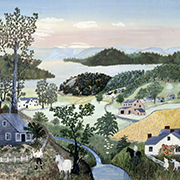
In October 1940, the Galerie St. Etienne presented an exhibition, titled simply “What a Farmwife Painted,” of work by an unknown self-taught artist named Anna Mary Robertson Moses. The gallery had been founded scarcely a year earlier by Otto Kallir, who had fled his native Austria following the Nazi Anschluss. Few art-world relationships have been as unlikely as the pairing of this Jewish refugee dealer with the elderly Yankee painter who would eventually become world-famous as “Grandma Moses.” That a recent Austrian emigré should have “discovered” one of the quintessential American artists of the “twentieth century speaks volumes about the intrinsic tolerance of American society. Kallir loved the “United States as only a refugee can, crediting it not just with saving his and his family’s lives, but with providing a freedom of opportunity that Austria could never, under any circumstances, have matched. Disappointed with the derivative art then common in New York galleries, Kallir was looking for an artist capable of capturing the authentic spirit of his new homeland. He found her in Grandma Moses.
“Grandma Moses” was an affectionate nickname that friends and family had given to Anna Mary Moses. The daughter of Mary and Russell King Robertson, Anna Mary was born in 1860 on a farm in upstate New York, about ten miles west of Bennington, Vermont. Like most farmers, she lived a life of constant hard work and occasional hardship. When she was twelve, she left home to earn her living as a “hired girl,” helping out on the farms of more prosperous neighbors. Schooling was a catch-as-catch-can affair—three months in winter, three in summer—with attendance often curtailed by bad weather or more pressing domestic chores. At the relatively late age of twenty-seven, Anna Mary married a “hired man,” Thomas Salmon Moses. The couple spent the initial eighteen years of their marriage in Virginia’s Shenandoah Valley. At first, they worked as tenant farmers, but eventually they saved enough to buy their own place. When times were tough, Anna Mary supplemented the family income by making and selling butter or potato chips. She gave birth to ten children, five of whom did not survive infancy.
In 1905, Thomas Moses persuaded his wife to return North, and they purchased a farm in Eagle Bridge, New York, not far from Anna Mary’s birthplace. The children gradually left home to start “families of their own, most settling in the area. After Thomas died of a heart attack in 1927, Anna Mary moved temporarily to Bennington to care for her daughter Anna, who was terminally ill with tuberculosis. It was here that, for the first time in her life, Grandma Moses had the freedom to indulge her interest in art. Picture-making developed as a natural extension of Moses’ domestic skills: she’d always decorated things around the house to make them prettier, and now, at Anna’s suggestion, she began creating embroidered landscapes in her spare time. Arthritis made it hard for her to hold a needle, however, and so Grandma gradually switched to paint, thereby embarking upon an unanticipated professional journey. Initially, Moses’s obsession seemed an odd indulgence. She soon had more pictures than she could give to family and friends, but when she tried exhibiting them at the country fair, alongside her prize-winning jams, the paintings received no notice. In the mid-1930s, she was invited to submit some of her work to a local “women’s exchange” sponsored by the drugstore in nearby Hoosick Falls, but again the pictures were largely ignored.
The pivotal event in Moses’ early career came in 1938, when a traveling collector, Louis Caldor, chanced upon the paintings in the drugstore and spontaneously bought them all. Caldor was an engineer who had emigrated to the U.S. from Hungary after World War I in active pursuit of the "American dream.” While his own career never quite took off, he more than made up for this in his prescient recognition of Grandma Moses. Still, at first Caldor must have appeared as foolhardy as the painting grandmother. He vowed—much to the bemusement of her family—to establish Moses professionally, and he began making the rounds of the New York galleries with a small collection of her paintings. Most dealers proved totally uninterested in devoting time and money to an artist who, then in her late seventies, seemed unlikely to live long enough to justify the investment. But after many months of fruitless effort, Caldor was referred through the emigré grapevine to Otto Kallir. Immediately impressed by the Moses paintings, Kallir agreed without hesitation to give the artist a one-woman show.
Moses’s debut at the Galerie St. Etienne came at the tail end of more than a decade of interest in self-taught art, which was actively championed by such art-world leaders as Alfred Barr, Director of the Museum of Modern Art. “Naïve” or “Primitive” painting was seen as an affirmation of the avant-garde’s anti-academicism, and Kallir’s experiences with modern art in Europe had in fact conditioned his receptivity to Grandma Moses. However, Moses quickly leap-frogged over the relatively narrow boundaries of the American “high” art establishment to reach an audience far larger than any ever before accorded a “fine” artist. The first painter to be taken up by the mass media, Moses benefited from such relatively new technological marvels as live-remote radio broadcasts and television, as well as the older vehicles of film and print. A plethora of Moses products—fabrics, plates, greeting cards, print reproductions and best-selling books—brought the artist’s work into millions of ordinary homes. While these Moses products seem modest by today’s marketing standards, the divide separating “high” and “low” art was sacrosanct during the 1940s and ‘50s. Thus the artist’s extreme popularity and commercial accessibility were felt by some to compromise her creative legitimacy.
Grandma Moses unwittingly became caught up in a battle for America’s artistic soul. After World War II, it grew evident that America needed an art commensurate with its new status as a superpower, and the U.S. government also soon recognized that art could be an important propaganda tool in fighting the Cold War. In the beginning, the exact form and content of this new American art were up for grabs. Modernism—as promoted by Barr and others before the war—was a distinctly European phenomenon. After the war, right-wing congressmen proposed that modernism was nothing less than a foreign Communist plot, a sneak attack on the nation’s creative vitality. President Harry Truman was certainly no fan of abstraction, which he called “ham-and-eggs art.” In keeping with this sensibility, he bestowed the Women’s National Press Club Award on Grandma Moses and, after the ceremony, entertained her at Blair House. When the U.S. Information Service began circulating exhibitions throughout war-torn Europe, Moses was one of the first artists to be signed on.
European audiences immediately took to Grandma Moses, whom they viewed without a trace of condescension and welcomed as an antidote to the perceived soullessness of American capitalism. However, this favorable response was misinterpreted by the American art establishment. “Europeans like to think of Grandma Moses… as representative of American art,” groused The New York Times in 1950. “They praise our naiveté and integrity… but they begrudge us a full, sophisticated artistic expression. Grandma Moses represents both what they expect of us and what they are willing to grant us.” In order to desvelop “a full sophisticated artistic expression,” America would need to hatch its own avant-garde, to snatch the reigns of progress and leadership from Europe. The advent of Abstract Expressionism in the late 1940s and early ‘50s seemed to provide just the ticket, and even the government’s naysayers eventually came to agree that abstraction had its advantages. Whereas much prewar American representational art had been left-wing in orientation, abstract art was mercifully free of overt content. It could thus conveniently be manipulated to serve a propaganda agenda juxtaposing democratic freedom with Communist oppression.
With this turn of events, Grandma Moses was relegated to a vast populist backwater. Mainstream art-world support for self-taught art had already dried up by the mid 1940s, squashed by the lobbying of trained American artists who felt wrongfully passed over by institutions such as MoMA. In the postwar period, contemporary artists and the museum establishment were at last in sync, united in favor of homegrown abstraction and against everything—representational, popular, “easy”—that might stand in the way of America’s international artistic hegemony. If Otto Kallir, who guided Moses’s career from 1940 onward, sometimes chafed that “his” artist was denied the sort of serious critical acclaim he felt she deserved, Moses herself was largely oblivious to such nuances. And despite her estrangement from the art-world elite, she only gained in global stature for the remainder of her very long life. In 1960 and ’61, her 100th and 101st birthdays were proclaimed "Grandma Moses Day” by New York’s Governor Nelson Rockefeller. When Moses died in December 1961, eulogies poured in from all over the world.
It is easy to understand what the Cold-War-era public, shaken by the recent memory of World War II and the new possibility of nuclear annihilation, saw in Grandma Moses. Her story could not have been more perfect had it been scripted by a Hollywood press agent. The farm, after all, is the prototypical American small business, combining self-sufficiency and independence with unsullied agrarian values. Moses was no Cinderella, plucked from the ash heap by a prince, but a female Horatio Alger, who made good by dint of talent and hard work. That she did so at an extremely advanced age also poignantly illustrated the adage, “It’s never too late.” While the coy “Grandma” moniker may have undercut her acceptance by the nation’s elite, it clearly struck a profound chord with the general public. Furthermore, Moses’s unassuming pose allowed her to slip below the radar screen that has generally prevented female artists from receiving renown comparable to that of their male colleagues. It is startling to think that Moses was not only one of the most successful artists of her time, she is probably the most famous woman artist of all time.
Like Norman Rockwell (with whom she is often compared), Grandma Moses is today undergoing something of a revival. The prejudices which “prompted some critics to dismiss her work have lifted, and the passage of time, while eclipsing the artist’s personal celebrity, has brought her paintings to the fore. “Grandma Moses in the 21st Century”—a loan exhibition curated by the Galerie St. Etienne that began a seven-venue tour in early 2001 and will be traveling through 2002—has evoked an unprecedented response from public and press alike. “Grandma Moses is back, and she’s enchanting” proclaimed Hilton Kramer, a critic not known as a soft touch. Peter Schjeldahl, writing in The New Yorker, concurred: “The paintings are always engaging, sometimes marvelous, and, after a long rest in genteel approbation, as good as new. . . .When you step up to a major Moses—near enough to behold cannily varied, unfussy textures and summary colors that affect the eye by temperature as well as by hue and tone—the picture’s scale turns vast and intimate simultaneously. Beauty happens.”
In order to transcend its historical moment, art must be pliable and ambiguous enough to be freshly interpreted by successive generations. Like the American flags that have become so ubiquitous since September 11, the paintings of Grandma Moses promote a sense of unity precisely because they are capable of embodying such disparate aspects of the American spirit. At one extreme is the harsh rigidity of nationalism, a “my-country-right-or-wrong” ethos that even ardent patriots sometimes question. At the other extreme is a profound tenderness, a belief in the flexibility of American society and in the human potential that flourishes when democracy is allowed free reign. Grandma Moses drew her broad-based audience from such inchoate interpretations of “American-ness,” but the ambiguities in her work could also provoke divergent reactions. Thus some found in Moses a kind of soothing nostalgia, while others rejected her for what they perceived to be cloying sentimentality. Both the artist’s admirers and her detractors projected onto Grandma Moses qualities that reflected their own agendas far more than they did her work or personality.
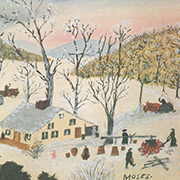
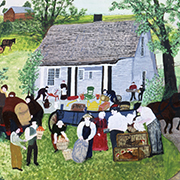
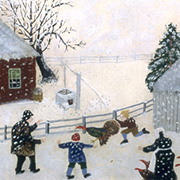
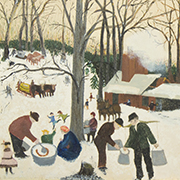
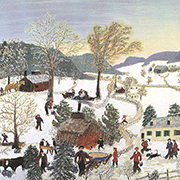
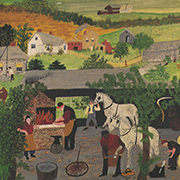
If a certain open-endedness characterizes all great art, the central ambiguity in Moses’s work derives from her relationship to the American past. In truth, Moses’s view of the past was neither nostalgic nor sentimental, but essentially allegorical. Unlike Norman Rockwell, Moses was not an illustrator, and whereas his characters have a specificity of appearance that identifies them with a distinct moment in history, the figures in a Grandma Moses painting are generic abstractions. Although her paintings are replete with “old-timey” details, such as women in long dresses and horse-drawn sleighs, these vignettes merely allude to the past, rather than slavishly replicating it. Considering how often Moses, in her heyday, was pitted against the rising American avant-garde, it is ironic to note that abstraction actually plays a pivotal role in her art, providing compositional structure while at the same time making her subjects universally accessible. The characters in a Grandma Moses painting are ciphers with whom almost anyone can readily identify.
The other half of Moses’s “secret” is realism, for whereas her figural vignettes are abstract, her rendering of the landscape is extraordinarily naturalistic. As a farmer, Moses was intimately familiar with the vicissitudes of weather, time of day and the changing seasons. And as an artist, she rapidly mastered the subtle color gradations and juxtapositions necessary to capture nature’s shifting moods. It is the landscape that breathes life into a Moses painting, lifting the allegorical vignettes from the past and carrying them into the present. In this manner, her work symbolically unites past with present, depicting them as an unbroken—and implicitly unbreakable—continuum that serves to secure the future. “Memory and hope,” as the artist herself put it, were the keys to her creative vision. In her art, as in her life, Moses looked backward and forward simultaneously. Her paintings expressed a profound faith in America’s heritage, and a firm belief that our values would endure and guide us safely into the future. Particularly cogent in the Cold War years, this is still very much a message for our own time.